
For a Work-Surface Protection Mat Solutions project, choose a flat format when tools, containers or equipment must cross the mat boundary and continuous wiping is important. Consider a raised-edge protective mat when managing minor surface spills is an explicit requirement and the perimeter will not obstruct access, cleaning or equipment clearance. Neither format is automatically better: the decision depends on the work surface, liquid exposure, movement pattern, cleaning process and evidence available from drawings or samples.
Define the geometry before comparing quotations. A flat mat has no intentional spill-retaining perimeter. A raised-edge mat has a perimeter feature that must be described separately from the mat body. Edge height, the transition into the usable interior area, total body thickness and surface texture are different measurements. Ninghow Mats can review application details, construction options and sample requirements, while available materials, edge profiles, sizes and finishes require project confirmation.
Flat or Raised-Edge Mats: Which Design Fits the Application?
| Decision factor | Flat format | Raised-edge format |
|---|---|---|
| Boundary access | Usually easier for tools, containers and equipment to cross | May interfere with movement or create a step at the perimeter |
| Cleaning | Supports continuous wiping across the work surface | Requires attention to corners, transitions and the inside edge |
| Minor spills | Does not intentionally retain liquid at the perimeter | May help manage a limited surface spill if geometry and conditions are suitable |
| Fit and clearance | Often simpler beside counters, fixtures and adjacent surfaces | Requires checks for edge height, tool clearance and usable interior area |
A practical first-pass rule is simple: prioritize a flat protective mat when access and wiping dominate; investigate a raised edge when spill handling has been defined well enough to evaluate. Before approval, record the liquid type, expected amount, spill location, cleanup process, equipment movement, surface slope and clearance around the mat. A raised perimeter should not be treated as leakproof or as certified secondary containment without application-specific design and testing.
Hypothetical buyer decision example
Scenario one: A buyer needs a custom mat for a bench holding small tools and containers. Tools frequently cross the boundary, cleaning requires uninterrupted wiping, and liquid type and volume are not documented. The trade-off favors starting with a flat-format evaluation because access is known to matter, while a raised-edge sample remains a conditional option if minor-spill management becomes a defined need.
Scenario two: A buyer works on a surface where occasional liquid spills occur inside a fixed work area, but carts and containers must still pass nearby. The trade-off may favor comparing both formats rather than selecting an edge from the spill concern alone. The next action is to provide bench measurements, photographs, liquid and cleaning details, surface slope and clearance information, then compare representative samples against an agreed checklist. These are planning examples, not Ninghow project evidence.
Choose a Flat Protective Mat When Access and Cleaning Come First
A flat protective mat design is generally the better starting point when the work routine involves frequent movement across the mat boundary. Tools may be picked up from outside the protected area, containers may slide into position, or fixtures may sit partly on and partly beside the mat. A low-interference perimeter can make these actions easier to repeat and can simplify edge-to-edge placement beside a counter, machine or adjacent surface.
The main limitation is equally important: a flat edge does not create a spill barrier. Liquid can move beyond the mat, particularly when the work surface slopes, the spill volume is more than expected, or the mat does not fit closely against surrounding surfaces. Debris can also migrate beneath an edge. The buyer should therefore define whether the mat is intended to protect against incidental contact and localized exposure, or whether the application needs a separate containment solution.
Evaluate the finished sample on the actual work surface rather than judging a material name alone. Place representative tools and containers on it, wipe it with the intended cleaning media, and observe flatness, surface feel, edge lift and fit. Separate displacement at the mat-to-surface interface from deformation within the mat construction. A mat may remain structurally intact while still moving on the bench, or it may stay in place while developing an indentation under a local load.
Flat-format suitability checklist
- Measure the work surface and identify counters, fixtures, joints and adjacent edges.
- Photograph normal tool, container and equipment positions.
- Record which items cross the mat boundary during routine work.
- Define liquid exposure and cleaning media, including the expected cleanup method.
- Check edge-to-edge placement, debris migration, edge lift and wiping access.
- Observe displacement at both the top contact interface and the backing interface.
- Ask Ninghow Mats to assess dimensions, surface, backing and thickness against the actual application.
Consider a Raised-Edge Protective Mat for Minor Spill Management
A raised-edge protective mat may be appropriate when a buyer has identified a limited surface-spill scenario and wants the mat perimeter to play a role in directing or retaining liquid temporarily. Start with facts rather than a general request for “spill proof” performance: identify the liquid, expected amount, likely spill location, contact time and cleanup response. These details determine what the edge must do and what a sample evaluation should observe.
Inspect the complete spill path. Edge height alone is insufficient. The review should include corner transitions, edge continuity, surface slope, texture, the usable interior area and any possible overflow route. A higher perimeter can also obstruct tools, carts, containers or wiping. The buyer must balance the intended spill-management benefit against the access that operators need every day.
Request a dimensioned edge section, corner detail and interior-area drawing, or evaluate a representative physical sample. Do not infer liquid resistance, sealing, chemical compatibility or leak prevention from edge geometry alone. Ninghow Mats can review containment-related requirements and confirm available edge profiles, materials, finishes and sample options for the proposed application. Any acceptance limit should be agreed for the specific construction, liquid and conditions.
Match Material, Layer Construction, Surface and Backing to the Work Surface
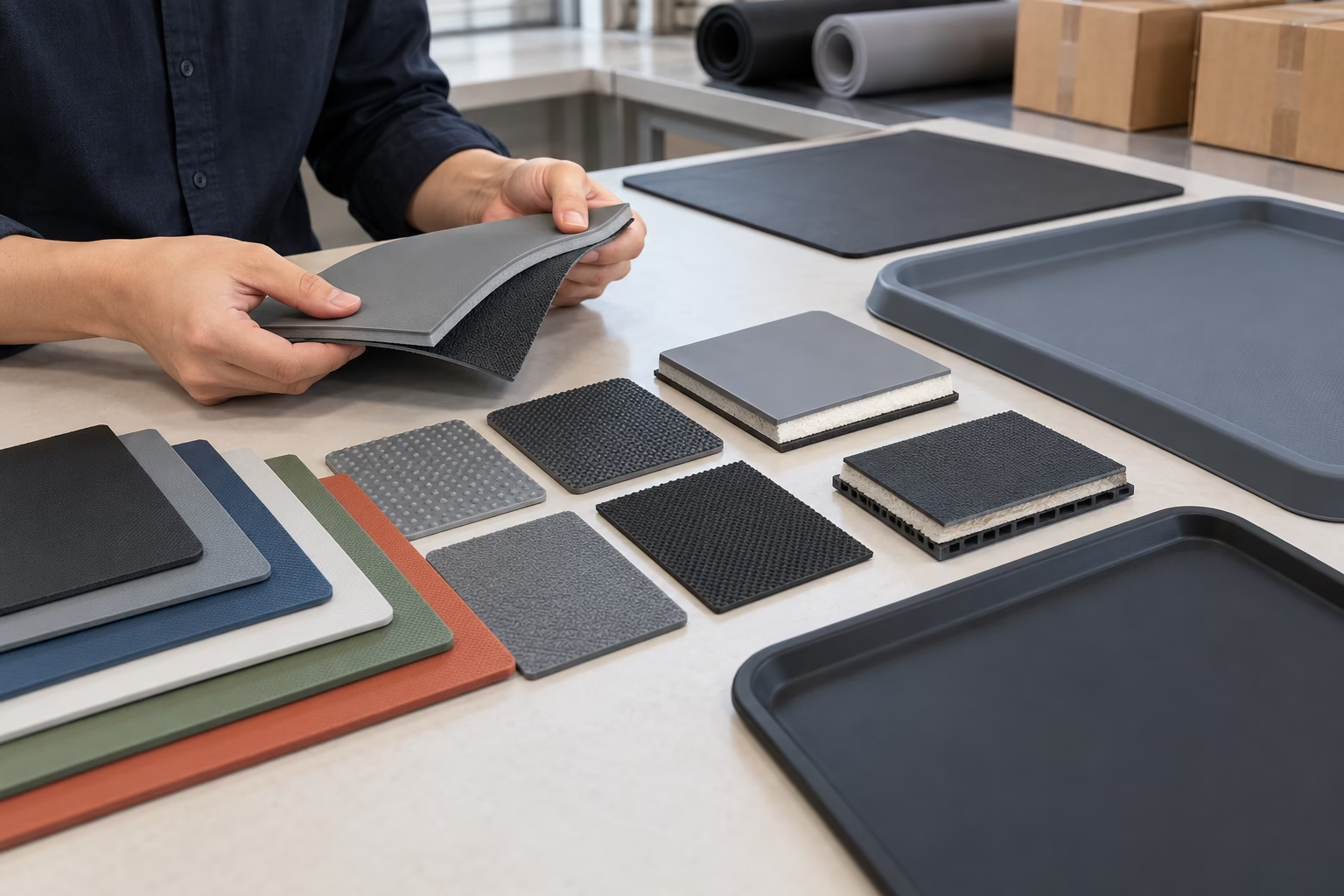
Edge format is only one part of a work-surface protection mat. The finished construction must also suit the protected object, scratch sources, local loads, debris, liquids and cleaning conditions. A surface that feels stable may still move at the backing interface, while a backing that grips well may be difficult to clean or unsuitable for the substrate.
Ask Ninghow Mats to identify the proposed wear surface, protective body, barrier or reinforcement, cushion layer and grip base where these layers apply. Material names alone do not establish finished-product performance. For specialist areas such as ESD-controlled workstations, material selection should be reviewed against the facility’s established grounding and handling procedures, as explained in this technical guidance on ESD work-surface material selection.
| Application concern | Evidence to request | Decision point |
|---|---|---|
| Point loads, tools or components | Layer description and application evaluation | Check indentation, support and recovery under defined conditions. |
| Liquid, staining or cleaning | Liquid details, cleaning media and observed sample response | Compare surface behavior with the actual cleaning process. |
| Displacement | Substrate description and installed-condition trial | Separate movement at the mat interface from deformation within the mat. |
| Surface protection | Protected-object description and scratch-risk review | Check the complete construction rather than relying on a material label. |
For dimensional control, measure the finished mat edge-to-edge after the agreed conditioning process. Measure total thickness at defined locations, and state whether raised texture or edge features are excluded. Common market ranges may help frame a discussion, but they are not Ninghow Mats specifications or project acceptance limits.
Hypothetical buyer decision example
A buyer needs a custom bench mat for small tools, containers and occasional liquid spills. Tools cross the boundary frequently, and cleaning requires continuous wiping, but the liquid type, expected amount, surface slope and equipment clearance are not documented. The practical decision is to begin with a flat-format evaluation because access currently dominates, while testing a raised-edge sample if minor spill management proves material. The next action is to provide bench measurements, photographs, liquid and cleaning details, then compare representative samples against an agreed checklist.
Specify Dimensions, Thickness, Printing, Cutting and Edge Details
Turn the preferred design into a specification brief that a buyer, designer and manufacturer can interpret in the same way. Provide finished length and width, units, overall shape, corner radii, cutouts, reference datums, usable interior area and equipment-clearance limits. Placement photographs are useful when counters, fixtures or adjacent surfaces affect the fit.
Copyable specification brief
- Application: protected object, work task, local loads, tools, liquids and cleaning process.
- Geometry: finished dimensions, shape, corner radii, cutouts, datums and measurement basis.
- Edge format: flat or raised edge, perimeter height, corner transition, edge finish and usable interior area.
- Construction: proposed material or grade, layers, surface texture, backing and substrate.
- Thickness: total body thickness, measurement locations and whether texture or raised features are excluded.
- Artwork: print location, artwork method, color reference, registration expectations and proof conditions.
- Acceptance: critical-to-fit features, project tolerances, sample observations and approval authority.
- Commercial handling: packaging geometry, label content, carton requirements, destination and shipment instructions.
Keep total mat thickness separate from raised-edge height. A raised perimeter can reduce usable interior area, affect tool access and change the wiping path. Likewise, surface texture can change the effective feel without changing the specified body thickness. Ninghow Mats can confirm available size, thickness, printing, cutting and edge-finishing options, but exact tolerances and production limits should be agreed through an approved drawing or sample.
Approve printed appearance and physical geometry as separate decisions. A print proof can show artwork placement and color review conditions; it does not by itself approve dimensions, edge transitions or fit. For a project-specific development step, use Custom Mat Sample Development to organize the sample inputs before quotation or bulk review.
Evaluate Samples, Control Quality and Release Packaging Requirements
A sample becomes useful only when it is compared with the approved application brief, drawing, artwork and construction description. Trial-place it on the intended work surface and use representative tools, containers and cleaning actions. Record observations rather than relying on general impressions such as “good quality” or “heavy duty.”
Pre-production sample inspection checklist
- Confirm dimensions, corner shape, cutouts, flatness and fit at agreed measurement locations.
- Check edge condition, raised-edge continuity, corner transitions and usable interior area.
- Inspect layer alignment, adhesion, surface feel, backing behavior and visible defects.
- Compare artwork location, color review result, registration and protected print areas with the approved proof.
- Observe displacement, debris migration, cleaning response and equipment clearance under defined conditions.
- Record each deviation, requested correction, responsible party, disposition and approval status.
Keep documents under independent control. A drawing, artwork file, physical sample, packaging brief and inspection record may each have its own identifier, revision and approval date. One release log should cross-reference the exact versions reviewed and approved together. This prevents a correct sample from being released with an outdated drawing or artwork file.
Packaging approval is separate from product approval. Define protection for edges, printed surfaces and geometry, then record label content, carton configuration, storage conditions and destination requirements. For additional manufacturing context, Ninghow’s Mat Quality Control and Color Consistency information can support the discussion, while project-specific inspection criteria still need agreement.
Use ASTM or ISO procedures only when their scope matches the construction and test being requested. A test method defines how an observation is made; it does not create a universal pass or fail limit. Ninghow Mats should confirm applicable sample, inspection and packaging information for the project, and the buyer should distinguish observed results from manufacturer statements or industry references.
For relevant company and manufacturing context, see Custom Silicone Mats.
Frequently Asked Questions
When should I choose a flat instead of a raised-edge work-surface mat?
Choose a flat format when tools cross the boundary, edge-to-edge placement and continuous wiping are more important than perimeter spill management. Confirm the decision with a representative fit and cleaning trial.
Does a raised edge make a work-surface mat leakproof or secondary containment?
No. Edge geometry may help manage a defined minor surface spill, but it does not prove sealing, chemical compatibility, leak prevention or regulated secondary-containment performance.
How should raised-edge height be specified separately from total mat thickness?
State perimeter height, edge transition, corner detail and usable interior area separately from total body thickness. Also define the measurement locations and whether surface texture is included.
What dimensions and clearance measurements should an OEM buyer provide?
Provide the work-surface length and width, shape, corner radii, cutouts, adjacent fixtures, equipment movement paths, tool heights and any critical clearance limits. Include photographs and units.
How should surface texture and backing be evaluated for displacement?
Trial the finished mat on the actual substrate with representative tools, contamination and cleaning conditions. Identify whether movement occurs between the mat and surface or within the mat construction.
What should be checked on a custom mat sample before bulk approval?
Check dimensions, flatness, fit, edge condition, layer alignment, adhesion, surface feel, backing behavior, artwork, cleaning response, packaging protection and all agreed acceptance points.