
Custom mat cost depends on the complete finished specification and order plan, not on one universal unit price. Material selection, layer construction, dimensions, cutting, artwork, sampling, packaging, quantity, destination and approval requirements can all change the quotation scope. Ninghow Mats needs these inputs defined well enough to assess the project before confirming quotation details. Where product suitability is still uncertain, Custom Mat Sample Development can help turn a general requirement into an agreed physical reference.
For a reliable comparison, send each manufacturer the same product requirements, quantity tiers, artwork status, packaging instructions and destination assumptions. A lower figure may reflect a narrower construction, fewer approval steps or excluded delivery work rather than a lower cost for the same finished mat.
What Determines Custom Mat Cost Before You Request a Quote?
A B2B quotation normally combines four scopes: the product specification, the conversion work needed to make it, the order requirements and the delivered-product plan. The product specification describes the material system, surface, backing, thickness, shape and visual treatment. Conversion covers cutting, forming, printing, edge treatment and other finishing. Order scope includes quantities by version, sampling, documentation and approvals, while delivered-product planning covers packaging, destination and shipment coordination.
Cost-driver analysis identifies what may change the quote; it does not calculate a universal price. For example, “rubber mat” or “foam mat” is not a complete specification because the grade, surface, backing, thickness and construction remain undefined. The buyer and manufacturer should agree which revision of the drawing, artwork, sample and packaging brief governs the quotation, along with inclusions, exclusions and unresolved items.
| Quote area | Confirmed | To be decided | Not applicable |
|---|---|---|---|
| Product | Material, layers, dimensions, shape and thickness | Grade, backing or edge treatment | Special insert or adhesive |
| Production | Cutting, printing and sample scope | Color approval or inspection method | Additional finishing |
| Order | Quantity by SKU and sample quantity | Target timing or approval sequence | Multiple versions |
| Delivery | Packaging level and destination | Labels, cartons or routing instructions | Retail presentation |
Use this structure to normalize offers before comparing bulk custom mat pricing. A practical document request should include the dimensioned drawing, production-ready artwork, material or grade information, physical sample requirements, packaging instructions and inspection expectations. Submit the completed brief through Ninghow Mats’ project contact route once the essential fields are assembled.
How Application, Material and Layer Construction Change the Quote
Start with the use environment rather than a preferred material name. Describe where the mat will sit, what contacts its surface, whether it will move, the expected load or pressure, how it will be cleaned and which environmental conditions matter. A desk mat, retail counter mat, exercise mat and work-surface protection mat may need different surface behavior, backing, cushioning and construction decisions.
Record the complete material system: surface layer, backing, carrier, adhesive if used, cushioning layer, grade and total finished thickness. A material name alone leaves quotation gaps. For example, a buyer requesting cushioning should state the relevant load, contact area, duration, recovery expectation and thickness constraint. The finished construction should then be assessed under defined conditions rather than judged from raw-material data alone.
Ninghow Mats should confirm whether the requested grade, layer arrangement, dimensions, thickness and process combination is available and suitable for the project. Supplier reference ranges, where provided, are context for discussion rather than Ninghow Mats acceptance limits. Any sample or test record should identify the load, contact area, duration, environment and observation method. This makes a performance discussion traceable without turning a test method into an automatic pass or fail requirement.
Material-input matrix
| Decision variable | Buyer input | Record to request |
|---|---|---|
| Application | Placement, users, movement and cleaning | Application description and photographs |
| Construction | Surface, backing, layers and thickness goal | Material data and manufacturer confirmation |
| Performance | Load, contact area, recovery and stability | Sample observations or defined evaluation |
| Suitability | Environment and process constraints | Grade and finished-construction review |
Link each priority to an observable decision. If cushioning matters, compare samples under the same stated conditions. If cleaning or appearance matters, document the cleaning method and inspection points. This approach helps separate a genuine construction difference from an unsupported assumption about material performance.
Which Dimensions, Thickness, Shape and Edges Need Pricing Definition?
Provide finished length, finished width, total thickness, measurement units, shape and any required tolerance. State whether dimensions are measured edge to edge and identify the measurement condition. Thickness should be defined as the finished product measurement, including any raised texture, surface profile or edge feature that affects the specified point.
A standard rectangle and a custom contour do not create the same cutting scope. Identify radiused corners, openings, cutouts, curves and other non-standard features on a dimensioned drawing or production-ready contour file. Also describe the edge result: exposed layers, trimmed edge, bonded edge, rounded treatment or another project-specific finish. Ninghow Mats can then assess applicable cutting and edge options rather than relying on assumptions from market references. Relevant cutting and finishing context is available through Laser Cutting, Die Cutting and Edge Finishing.
Use area or material-planning calculations only after the finished geometry and nesting assumptions are fixed. The material area consumed during production is not automatically the same as the finished edge-to-edge area. Quantity, layout efficiency, cutouts and protective margins may affect planning, while the quotation must still identify the agreed finished dimensions.
Geometry checklist
- Finished length and width, with units and measurement points
- Total thickness and any raised texture or profile
- Rectangle, contour, opening, cutout and corner radius details
- Edge treatment, exposed layers and required cut quality
- Nominal dimensions, acceptable variation and inspection locations
- Dimensioned drawing or approved contour artwork
Before comparing offers, make sure every supplier is quoting the same geometry, thickness basis, edge treatment and inspection expectation. Available sizes, thicknesses and tolerances must be confirmed for the specific project; they should not be treated as guaranteed Ninghow Mats capability merely because a similar market product exists.
Hypothetical quote-comparison example
A private-label buyer has a known application and finished rectangular length and width, but has not defined thickness, print coverage, color approval, edge treatment, unit packaging or destination. Two quotations may therefore describe different constructions and delivery scopes. The buyer’s next action is to issue one normalized brief with the same artwork, quantity tiers, destination and approval requirements, then record each manufacturer’s open items before evaluating price.
How Do Printing, Artwork and Approval Requirements Affect the Quote?
Printing affects a quotation through more than the presence of a logo. The brief should identify print coverage, placement, the number of versions or SKUs, variable information and any protected areas. A full-surface design, a small marked area and several versioned artworks may create different preparation, sampling and production scopes.
Supply production-ready artwork where available, together with placement dimensions and a clear color reference. State whether the artwork is final, under review or still being developed. If the design includes text, barcodes, registration-sensitive details or variable information, identify those elements before a supplier assesses the project.
Approval requirements should be explicit. Decide whether the project needs a digital artwork review, a physical sample, a color review or another documented approval step. Artwork preparation is a separate scope from physical printing and sampling, so each should be visible in the quote assumptions.
Print Brief Fields to Make Comparable
| Input | What to define | Evidence or action |
|---|---|---|
| Artwork status | Draft, under review or approved | Attach the current artwork and approval owner |
| Coverage and placement | Full surface, selected area, orientation and protected zones | Provide an annotated placement diagram |
| Color reference | Reference system, visual target or approved color sample | State how color will be reviewed |
| Versions | SKUs, regional versions or variable information | List each version and its quantity basis |
| Release control | Artwork identifier, revision and approval date | Cross-reference it with the approved sample |
Keep artwork status and the physical sample revision separate. A drawing, artwork file, sample and packaging brief may each have its own identifier, revision and approval date. A single release log should cross-reference the exact versions reviewed and approved together. For project-specific artwork and sampling review, buyers can use the Mat Quality Control and Color Consistency resource alongside the quotation discussion.
How Do Finishing, Packaging and Shipment Requirements Change the Delivered Cost?
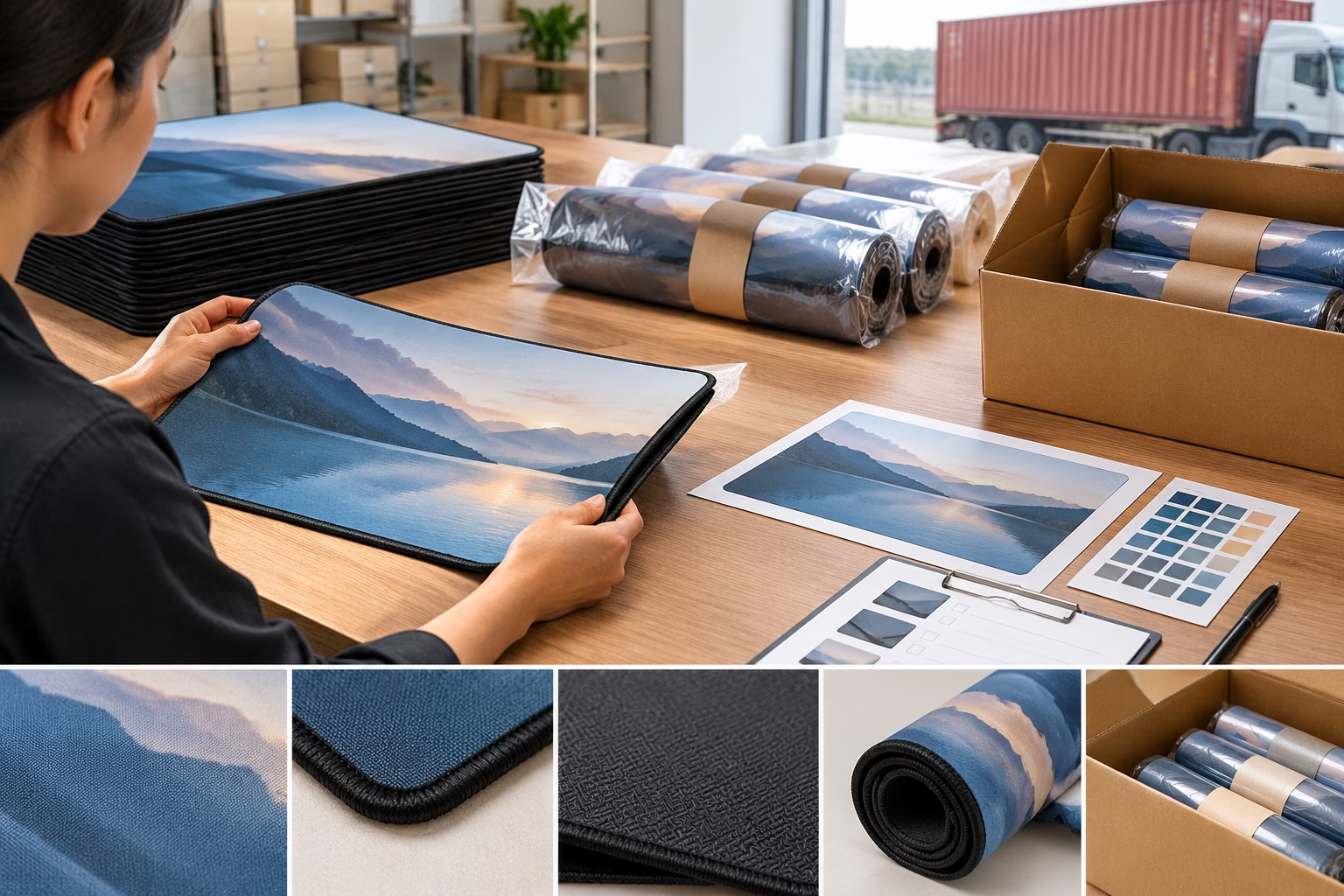
The delivered product is not only the mat itself. Cutting, edge treatment, lamination, protective films and other finishing details should be listed separately because they can change the production scope. Describe the required edge appearance, exposed layers, protection needs and any finishing sample that must be approved.
Packaging also needs a defined commercial scope. Record whether each mat is individually packed, grouped into an inner pack, placed in a master carton or palletized. Include labels, inserts, barcodes, retail presentation and carton protection when relevant. Give the expected quantity per carton only when it has been decided or ask the manufacturer to propose a configuration for review.
Delivered-Cost Scope Checklist
- Finished product: mat construction, print, cutting, edge treatment and any protective finish.
- Unit presentation: bag, sleeve, wrap, label, insert or retail-ready presentation.
- Outer packaging: inner packs, master cartons, carton quantity, protection and pallet preference.
- Shipment basis: destination, routing instructions, shipment coordination and delivery documents.
- Responsibilities: who supplies labels, approves packaging, prepares documents and handles unresolved changes.
State the destination and shipment assumptions with the same care as the product dimensions. Documentation, routing instructions and packaging presentation can change the scope even when the mat specification is unchanged. Ask Ninghow Mats to confirm applicable finishing and packaging configurations for the selected construction and to separate product, packaging, documentation and shipment assumptions in the quotation.
What Should a Buyer Put in a Custom Mat Quote Request?
A useful quote request gives every manufacturer the same decision inputs. Mark each field as confirmed, to be decided or not applicable. This makes missing information visible and prevents one supplier from pricing a complete scope while another prices only the basic mat.
Reusable Custom Mat Specification Brief
| Brief area | Required buyer input | Supporting evidence |
|---|---|---|
| Application | Placement surface, users, environment and performance priorities | Use description, photos or evaluation notes |
| Construction | Material preference, surface, backing, layers and thickness goal | Material data, reference sample or manufacturer confirmation |
| Geometry | Finished dimensions, units, shape, corners, edges and tolerances | Dimensioned drawing or approved contour artwork |
| Branding | Artwork, coverage, placement, colors and number of versions | Artwork files and annotated print brief |
| Approval | Digital review, physical sample, color approval and owner | Approval record and sample observations |
| Order scope | Quantity by SKU, sample quantity, timing and destination | Quantity tiers and shipment assumptions |
| Packaging | Unit pack, labels, inserts, cartons, pallets and documents | Packaging diagram or approved packaging sample |
Attach the drawing, artwork, material information, sample observations, packaging instructions and inspection expectations. Ask each manufacturer to identify inclusions, exclusions, open questions and approvals still required. Before comparing bulk custom mat pricing, align the geometry, construction, artwork scope, packaging, quantities and destination assumptions.
Final Quote-Review Checklist
- Same finished dimensions, thickness basis, shape and edge treatment
- Same material or construction definition and performance priorities
- Same artwork coverage, versions, color review and sample requirement
- Same finishing, unit packaging, carton and pallet assumptions
- Same quantity tiers, destination, documentation and shipment scope
- Same approval status, revision references, inclusions and exclusions
Once the brief and attachments are assembled, submit the same project information through the Contact Ninghow Mats channel. The manufacturer can then identify project-specific questions and confirm which construction, finishing, sampling, packaging and shipment details can be assessed for quotation.
For relevant company and manufacturing context, see Custom Silicone Mats.
Frequently Asked Questions
Why is there no universal price for a custom mat?
Custom mat cost depends on the finished construction, dimensions, printing, finishing, order scope, packaging and shipment assumptions. A material name or general size does not define a comparable quotation.
Which specifications should be confirmed before requesting a custom mat quote?
Define the application, construction, dimensions, thickness, shape, edges, artwork, approval process, quantities, packaging, destination and required documentation. Mark undecided fields so suppliers can identify the remaining gaps.
Does a larger mat always cost more?
Size can change material planning and production scope, but it is not the only variable. Shape, quantity, layout assumptions, construction, printing, finishing and packaging also affect the quotation.
How can thickness and layer construction affect a quote?
Thickness and layers influence the finished product definition, material use and evaluation needs. Specify the surface, backing, carrier, cushioning layer and total thickness, then ask the manufacturer to confirm suitable available construction options.
What artwork information does a manufacturer need?
Provide artwork status, print coverage, placement, color reference, protected areas, versions and variable information requirements. State whether digital review, physical sampling or color approval is required.
Why do packaging and shipment requirements belong in the quote request?
Packaging components, labels, carton configuration, palletization, destination and delivery documents can change the delivered scope. Listing them separately helps buyers compare quotations on the same assumptions.