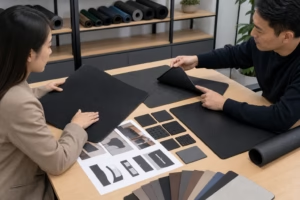
PORON and neoprene are not interchangeable material names. PORON is a Rogers-branded polyurethane foam family, while neoprene is a polychloroprene rubber material. For a cushioning-led project, a grade-specific review of Custom PORON and PU Foam Mats may be appropriate. For a rubber-based mat, neoprene may deserve evaluation when its formulation, surface system and exposure conditions fit the application.
The practical choice is between complete constructions, not isolated foam sheets. Grade, density, hardness, thickness, facing, backing, adhesive, printing and edge treatment can change the finished result. Ninghow Mats can compare candidate materials within a defined custom-mat build, while the available grade, construction, thickness, fabrication method, sampling route and lead time must be confirmed for the specific programme.
PORON vs. Neoprene: Which Material Fits the Mat Application?
Start with the function the mat must perform. If engineered cushioning and compression-response behavior are central requirements, PORON may warrant a grade-specific investigation. If the specification calls for a rubber-based construction, neoprene may be a candidate, provided the selected formulation and complete surface and backing system are compatible with the environment.
Compression set describes the amount of thickness or shape that remains lost after a material has been compressed and released under defined conditions. Recovery describes how much the material returns after the load is removed. Neither term, by itself, establishes service life. A supplier test result applies to its stated grade, specimen and method; it does not automatically predict a finished mat with different layers, contact areas or temperatures.
| Decision question | PORON evaluation | Neoprene evaluation |
|---|---|---|
| Material identity | Rogers polyurethane foam family; selected grade must be documented. | Polychloroprene rubber; exact formulation and construction must be documented. |
| Primary reason to investigate | Cushioning and compression-response requirements are prominent. | A rubber-based construction is requested and fits the exposure and surface design. |
| What remains unknown | Finished behavior depends on grade, thickness and layer arrangement. | Finished behavior depends on formulation, facing, backing and conditions. |
| Buyer decision | Compare the finished construction under defined use conditions. | Compare the finished construction under the same defined conditions. |
Use the table as a screening tool, not as a universal ranking. Ordinary polyurethane foam should not automatically be described as PORON, and “neoprene” alone is not enough to establish chemical resistance, grip, printability or durability. A project record should separate supplier material data from the finished-mat requirements and identify which points still need confirmation.
Compare Cushioning, Compression Set and Recovery Under the Same Conditions
A fair PORON vs neoprene foam comparison begins with matched specimens. Record the material grade or formulation, each layer, component thickness and total finished thickness. Then define the load, contact area, loading duration, cycle pattern and temperature. Without these conditions, two compression results may look comparable while describing different tests.
Measure initial thickness at agreed locations after a defined conditioning period. After loading, record thickness at the same locations and state when the measurement was taken. Immediate recovery and recovery after a longer elapsed period answer different questions. Also record whether the specimen was tested as raw foam or rubber, as a laminated build, or as the production-representative mat.
Compression-force deflection describes the force needed to compress a specimen by a specified amount. Compression set describes retained deformation after a defined compression exposure. They are related to cushioning decisions but are not interchangeable measurements. ASTM D3574, ISO 2439 or ISO 3386-1 may be relevant depending on the material and construction, but a standard defines a test method, not a universal pass or fail value.
Illustrative Buyer Decisions
Scenario 1: branded work-surface mat. The buyer has target dimensions and artwork, but has not selected a PORON grade or neoprene formulation. The load, cycle frequency, temperature and cleaning exposure are undocumented, and no finished thickness or backing compatibility has been defined. The practical decision is to request comparable constructions first. The next action is to submit the application brief, drawing, artwork, exposure information and sample criteria for a grade and construction review.
Scenario 2: repeated localized loading. A buyer wants cushioning beneath a small contact area and is considering a PORON foam alternative to neoprene. The trade-off cannot be decided from the material names because localized pressure may produce different results from broad, light loading. The buyer should provide contact geometry, load profile, cycle frequency and temperature, then compare production-representative samples under those conditions.
Use this worksheet before ranking either material: specimen construction; component and total thickness; load and contact area; loading duration; number and pattern of cycles; temperature and conditioning; initial thickness; post-load thickness; recovery elapsed time; measurement locations; observations. Reject incomparable data before choosing a material. Supplier data can screen candidates, but a finished sample tested at the intended contact interface is the stronger basis for a project decision.
Match the Material to the Surface, Backing and Exposure
A custom mat is a layered system. Define whether the top is exposed foam, textile, film, a printed layer, a laminated cover or a protective facing. Then specify the underside contact surface, whether displacement is a concern, and how the mat will be cleaned. Surface traction and backing displacement are separate issues: a textured top does not prove that the underside will remain stable on every substrate.
List actual exposure rather than using broad labels such as “industrial” or “chemical resistant.” Identify oils, cleaners, moisture, heat, ultraviolet exposure, dust and tools, including chemical names where known, concentration, contact duration and cleaning frequency. Compatibility can change with formulation, facing, temperature and exposure time, so the complete stack-up should be evaluated.
| Requirement to define | Candidate layer or interface | Evidence still needed |
|---|---|---|
| Cushioning and localized loading | PORON or neoprene layer with specified thickness | Matched compression and recovery measurements |
| Printed appearance | Surface film, textile, coating or laminated facing | Print adhesion, registration, color and cleaning observations |
| Stable placement | Backing, adhesive or carrier selected for the substrate | Displacement, residue and substrate-compatibility checks |
| Exposure resistance | Complete material and interface stack-up | Defined contact and cleaning evaluation |
Ask whether the priority is cushioning, protection, cleanability, grip, appearance or printability, then assign each priority to a layer or test. Neither PORON nor neoprene alone proves anti-slip behavior, oil resistance or service life. Before sampling, agree on the surface, backing, adhesive, exposure limits and observations that will determine acceptance.
Translate the Choice into Dimensions, Thickness and Fabrication Requirements
Material selection becomes practical only when the finished mat is defined. Provide the required length, width, shape, holes, cutouts, corner geometry and measurement units. State whether dimensions apply before or after conditioning, and identify the datum or edge used for each critical measurement. This gives Ninghow Mats a clear basis for reviewing fit and converting the design.
Separate total finished thickness from the thickness of each component. A printed facing, adhesive, carrier, backing or edge feature can change the stack-up without changing the name of the cushioning layer. Record the measurement locations and whether texture, compression, lamination or edge treatment is included. Component thickness information is not automatically a finished-mat tolerance or available Ninghow Mats capability.
Printing, lamination, die cutting and edge finishing should be treated as construction decisions. Geometry can affect cutting quality, while compression and bonding can influence the final profile or fit. Ninghow Mats can review these points from the drawing, artwork and intended construction; the available grade, thickness, edge, print and production approach still require project confirmation. Relevant converting questions may include Laser Cutting, Die Cutting and Edge Finishing.
Buyer Specification Brief
- Application: user contact, load pattern, placement surface and environmental exposure.
- Geometry: finished dimensions, units, shape, datums, cutouts, holes, corners and tolerances.
- Stack-up: PORON or neoprene grade, each component thickness, facing, adhesive, backing and total thickness.
- Appearance: artwork, print area, color references, surface texture and edge appearance.
- Program: quantity tiers, packaging, labeling, destination and target date.
Mark each item as buyer-provided or manufacturer-confirmed. This separation prevents a supplier reference range or preliminary suggestion from becoming an assumed production specification.
Evaluate Samples for Performance, Appearance and Production Readiness
A sample should answer whether the proposed construction fits the written application, not merely whether the material feels suitable in hand. Where possible, compare PORON and neoprene samples using the same dimensions, thickness definition, surface system and backing. Record conditioning and test conditions before comparing compression, recovery or dimensional observations.
Inspect the sample in four groups. Visual checks cover color, surface finish, print registration and visible defects. Dimensional checks cover length, width, cutouts, corner geometry, flatness and thickness at agreed locations. Construction checks cover the identity of each layer, backing adhesion, lamination and edge treatment. Functional checks cover fit, contact behavior, cleaning response and the intended loading pattern.
Photographs and measurement records should identify the sample construction in plain language. A release log should record each drawing, artwork file, specification and physical sample with its own identifier, revision, approval date and status. It should also show which exact versions were reviewed and approved together. One universal revision code or date for every item can hide an artwork change or a revised physical build.
For organized inspection records, buyers can use Mat Quality Control and Color Consistency as a relevant Ninghow Mats reference point. Observed sample behavior remains evidence about that construction under those conditions; it does not automatically prove a raw-material claim or future service life.
Illustrative Buyer Decision
A buyer needs a branded work-surface mat with localized repeated loading and a specified underside contact surface. The dimensions and artwork are available, but the PORON grade or neoprene formulation, load cycle, temperature, cleaning exposure, finished thickness and backing compatibility are not defined. The practical decision is to request comparable constructions and agree on evaluation conditions before choosing by material name. The next action is to submit the application brief, drawing, artwork, exposure information and sample criteria for a grade and construction review.
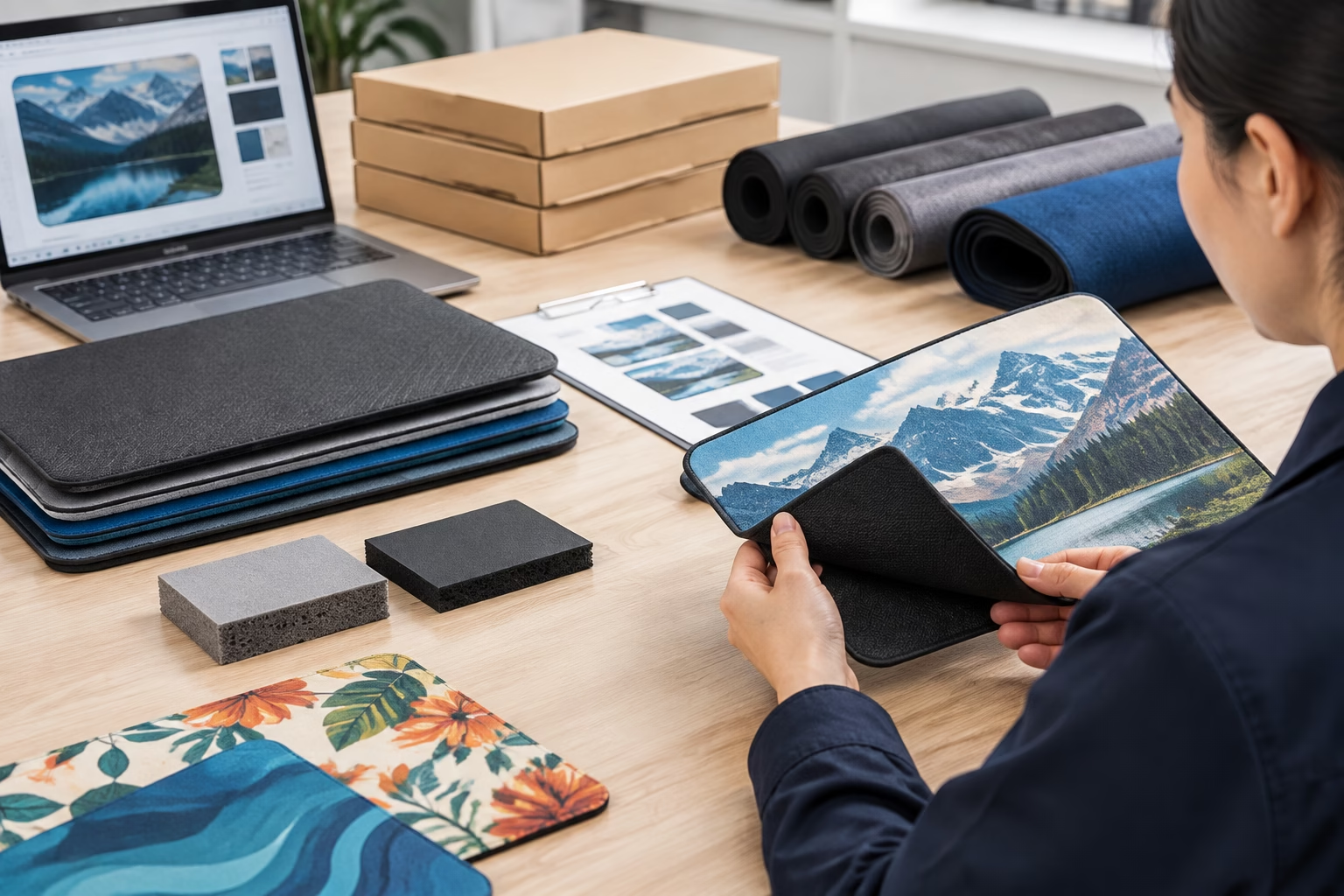
Prepare a Complete PORON or Neoprene Mat RFQ
A useful RFQ describes the product as a complete system. Explain who uses the mat, how it is loaded, how often loading occurs, what surface it contacts, what cleaning or chemical exposure is expected and what product life the programme is targeting. Avoid broad descriptions such as “industrial” or “chemical resistant” when specific substances, temperatures or contact durations can be identified.
Attach a dimensioned drawing and state the measurement basis. Include the layer stack, surface, backing, print, cutouts, edge treatment and packaging requirements. For a cushioning-led project, ask for grade-specific PORON or PU foam review; ordinary PU foam should not be described as PORON without appropriate identity and procurement evidence. For neoprene, request data for the exact formulation, facing, backing and thickness being proposed.
RFQ Document Request List
- Material identity, grade or formulation and supplier technical data.
- Construction drawing showing component layers and finished thickness.
- Applicable test methods, specimen conditions and limitations of the data.
- Sample plan covering dimensions, appearance, function, exposure and inspection.
- Artwork, packaging, labeling and destination requirements.
- Manufacturer response separating confirmed items, assumptions, exclusions and required tests.
Compare quotations only when the material identity, layer arrangement, dimensions and evaluation criteria align. A lower or more familiar material name is not necessarily the better choice if its construction cannot be compared on the same basis.
Once the brief is complete, request a production-representative sample through Custom Mat Sample Development. Ask Ninghow Mats to confirm available materials and grades, construction, sampling, packaging and lead-time expectations for the defined programme before treating any proposal as a production commitment.
Frequently Asked Questions
Are PORON and neoprene the same material?
No. PORON is a branded polyurethane foam family, while neoprene refers to polychloroprene rubber. They should be evaluated as different material families and as parts of complete mat constructions.
When should a buyer evaluate PORON instead of neoprene for a custom mat?
Evaluate PORON when engineered cushioning and compression-response behavior are central requirements. Evaluate neoprene when a rubber-based construction, surface system and exposure conditions suit the application. The exact grade and finished stack-up still require confirmation.
Can ordinary PU foam be described as PORON?
No. PORON is a specific branded material family. Ordinary polyurethane foam should not be given that name without appropriate grade identity and procurement evidence.
What information is needed to compare compression recovery fairly?
Define specimen construction, thickness, load, contact area, loading duration, cycle pattern, temperature, conditioning state and recovery measurement time. Reject comparisons based on materially different samples or test conditions.
Does the material name determine finished mat thickness or performance?
No. Grade, density or hardness, layer arrangement, facing, backing, thickness and fabrication affect the finished product. Finished performance must be evaluated against the intended application.
How should printing, backing and edge treatment affect the material decision?
They should be reviewed as part of the complete construction. Printing may require a suitable facing, while backing and edges can affect adhesion, displacement, appearance and fit. Confirm feasibility with a representative sample.