
A workbench mat roll is generally worth evaluating when your program needs continuous coverage, variable lengths or controlled trimming at the installation site. A Custom Workbench Mats program is generally better suited to standardized stations, repeatable replacements, individual packaging or branded finished kits. The right choice depends on who controls final measurement, cutting, edge quality, packaging and approval.
These are different supply formats, not automatic statements about material performance. Ninghow Mats can review the requested format against the application, construction, dimensions and shipment requirements, but availability must be confirmed for the selected material, grade, width, thickness, finishing and program scope.
Choose Roll or Cut-to-Size Format From the Program Requirement
Start with the operating model rather than the product name. Roll stock can reduce the need to order every possible bench length, but it transfers downstream work to the buyer or installer. That work may include measuring, trimming, managing waste and checking whether the finished edge and usable area still meet the drawing.
A cut to size workbench mat arrives as a defined article with agreed finished dimensions and features. This can simplify station deployment, replacement purchasing and individual packaging when the geometry, edge treatment and construction have been approved. It does not remove the need for a sample or dimensional agreement; it moves more of the conversion and inspection responsibility into the manufacturing review.
| Decision variable | Roll material | Finished cut-to-size mat | Ownership to clarify |
|---|---|---|---|
| Layout | Useful for continuous runs or changing lengths when usable width is confirmed. | Useful for repeated stations and defined replacement locations. | Buyer supplies the layout; manufacturer confirms feasible format. |
| Cutting | Buyer or installer may control final trimming, cutouts and waste. | Manufacturer reviews the finished geometry and edge requirements. | Specify the cutting party, tools, template and inspection method. |
| Handling | Receiving, storage, lifting and unrolling need planning. | Pieces may be easier to identify and deploy by station, subject to packing feasibility. | Agree handling units, labels and shipment configuration. |
| Replacement | Replacement consistency depends on the buyer’s cutting controls. | Repeatability depends on retained drawings, approved construction and identifiers. | Maintain a clear size and revision record for each replacement item. |
| Approval risk | Final fit may remain uncertain until site cutting is complete. | Fit and finish can be checked before shipment through an approved sample. | Define finished dimensions, tolerances and acceptance conditions. |
Applied Format-Selection Example
Hypothetical scenario A: A buyer is standardizing several assembly benches with different lengths and fixture cutouts. The buyer knows the bench dimensions, quantities by station and intended shipment configuration, and the application includes tool loading, debris and routine cleaning. Finished mats deserve priority for standardized stations because repeatable replacement and controlled cutouts are important.
Hypothetical scenario B: The same buyer may review roll stock for locations where variable lengths justify controlled downstream cutting. The evidence gap is material and format availability, dimensional tolerances, backing suitability, edge requirements and packaging constraints. The next action is to send measured drawings, cutout locations, quantity tiers, artwork, installation details and packaging requirements for manufacturer review and sample planning. This is a selection method, not evidence from a Ninghow Mats customer project.
Match the Format to Bench Layout, Installation and Handling
Map the bench before requesting a format recommendation. Record continuous runs, separate stations, changes in bench depth, fixture positions, obstructions and locations that may need replacement independently. A photograph can provide context, but measured drawings are more useful when they identify the usable area, reference edges, cutout centers and clearances.
State units and measurement conditions consistently. Distinguish nominal dimensions from finished edge-to-edge dimensions, and identify whether a dimension is measured before or after agreed conditioning. For cutouts, show the center location, shape, size and reference edge. If the drawing does not define these references, a dimensional mismatch may be caused by interpretation rather than manufacturing.
| Layout question | Buyer input | Format implication |
|---|---|---|
| Are lengths uniform? | Quantity by size and replacement locations. | Uniform stations may favor finished mats; changing lengths may justify roll review. |
| Are there cutouts or obstructions? | Dimensioned drawings or marked photographs. | Finished cutting may improve repeatability when the geometry is feasible and approved. |
| Who installs the mat? | Installer, tools, templates and waste-disposal responsibility. | Roll stock requires stronger downstream cutting and inspection controls. |
| How will units be received? | Storage space, labels, shipment configuration and handling limits. | Packaging and identification may influence the practical choice as much as the bench geometry. |
Ask Ninghow Mats to review measured bench drawings or photographs before treating either format as executable. Finished-mat deployment may improve repeatability when agreed dimensions, edges, packaging and labeling are feasible. Tolerance allocation remains a buyer-manufacturer agreement, not an implied universal value.
Specify Material, Layers, Surface and Backing Before Format
Format cannot compensate for an incomplete construction brief. Describe the tools, loading points, debris, cleaning media, contact surface and retrieval tasks. Explain whether the mat must remain stable during work, whether parts must be easy to pick up, and whether point loading or indentation is a concern. These details help separate a material preference from a functional requirement.
Describe each construction function separately: the working surface, any cushioning or body layer, and the underside backing or retention feature. Chemical, heat, cut, load, ESD and slip requirements should include the relevant conditions and the evidence needed for approval. A material name alone does not establish finished-product performance or service life.
Construction Specification Brief
- Application: tools, loads, debris, cleaning media and contact surface.
- Surface function: part retrieval, texture, appearance and cleaning expectations.
- Body or cushioning layer: required support, resilience or cushioning purpose.
- Backing: contact material, retention objective and installation conditions.
- Dimensions: finished width and length, measured edge-to-edge after agreed conditioning.
- Thickness: total thickness, measurement locations and whether raised texture or edge features are included.
- Approval evidence: sample observations, application evaluations and project-specific acceptance limits.
Ninghow Mats can confirm relevant material families, grades, layer constructions and thickness options during review. Any market or supplier reference range should be treated only as context, not as Ninghow Mats stock, tolerance or guaranteed capability. Confirm the grade, total thickness, layers and construction for the specific program before comparing roll and finished-piece quotations.
Control Dimensions, Printing, Cutting and Edge Requirements
A format decision becomes executable only when the finished geometry is defined. State width, length, total thickness, corner treatment, cutouts, radii, reference edges and the required measurement method. “Nominal” dimensions describe the intended size; finished edge-to-edge dimensions describe what the buyer will receive and install.
For a workbench mat roll, also define the maximum usable width, required cut lengths, nesting assumptions and who performs final trimming. This transfers responsibility for tools, templates, edge appearance, waste and final fit to the buyer or installer unless the manufacturer confirms another arrangement. For a cut to size workbench mat, define the finished edge, flatness expectation, cutout centers and any registration-critical features.
Use a Buyer-Ready Specification Brief
- Physical geometry: finished width, length, thickness, shape, corner radius, cutouts, hole centers and reference edges.
- Measurement basis: units, conditioning requirements, measurement locations, tolerance method and acceptance condition.
- Surface and backing: texture, usable area, underside construction, edge profile and installation interface.
- Artwork: print area, orientation, protected zones, color reference, artwork approval and physical sample approval.
- Format control: usable roll width or finished-piece dimensions, trimming method, packaging and labeling.
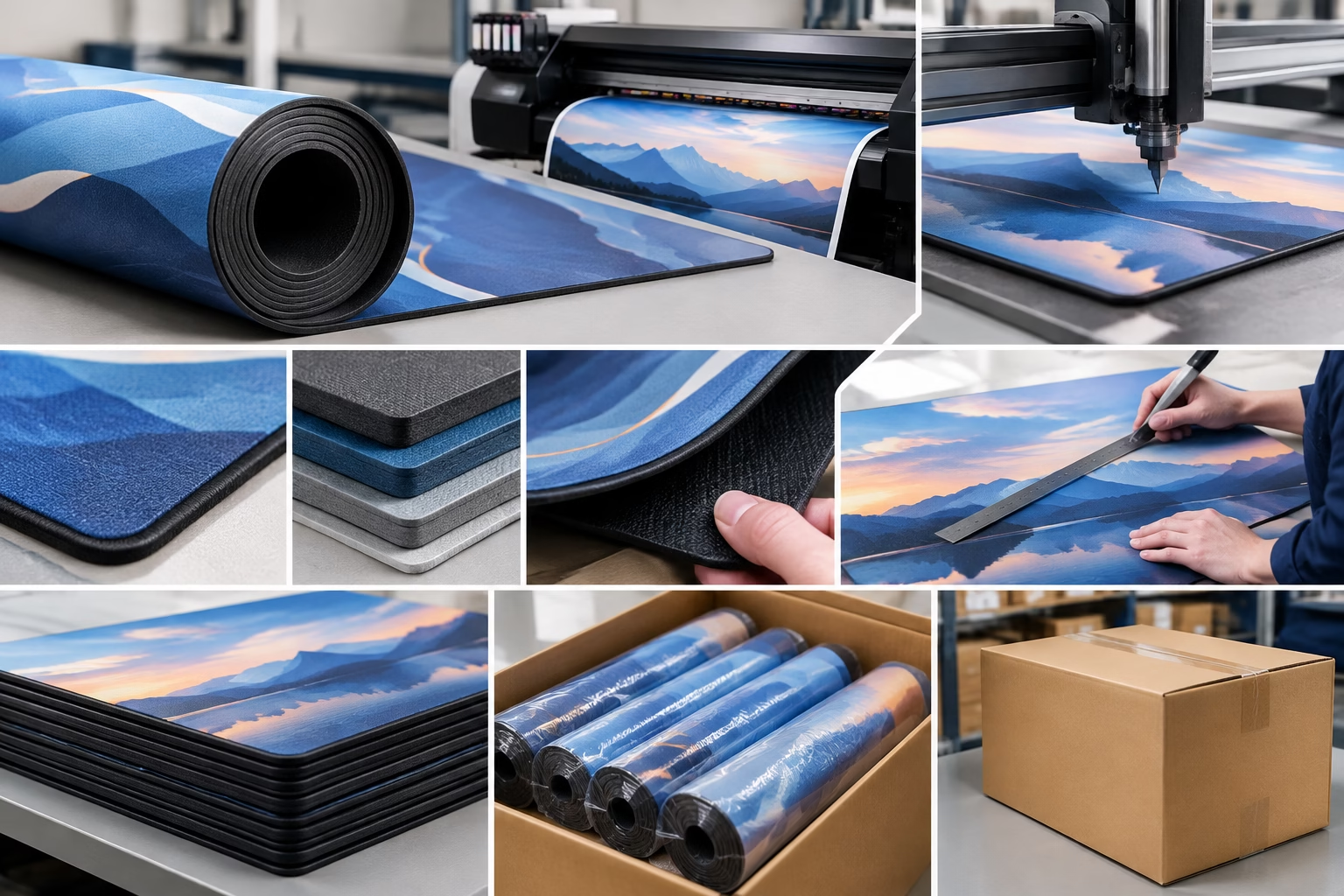
Artwork approval and physical approval should remain separate decisions. A logo can be approved for appearance while the mat drawing remains open for a cutout or edge change. A new review may be needed when the material, construction, dimensions, print placement or finishing changes. Ninghow Mats can review printing, cutting, edge and geometry options, subject to the selected material, grade, construction and program scope. See the cutting and edge-finishing capabilities for relevant manufacturing context.
Evaluate Samples and Release Quality Records
Approve a sample against the actual decision it must support. Trial-fit it on the real bench, or on a representative setup with the same placement surface and relevant obstructions. Check cutouts, edges, flatness, indentations, displacement, tool stability, surface condition and print placement. For roll material, evaluate the proposed trimming method as well as the material itself.
Record the conditions behind each observation: tools or loads, debris, cleaning media, contact surfaces, conditioning and installation method. This helps distinguish a dimensional mismatch from a reference-edge error, and a bowed mat from a construction, packaging or site issue. A sample result applies to the defined conditions; it is not a universal performance guarantee.
Pre-Production Inspection Checklist
- Identity: match the sample to the approved material, construction and intended format.
- Dimensions: measure width, length, thickness, cutouts and radii using the agreed method.
- Finish: inspect surface, backing, flatness, corners, edges and visible cutting marks.
- Artwork: compare placement, orientation, color reference and protected areas with the approved artwork.
- Application: trial-fit the mat and record movement, indentation, tool stability and cleaning observations.
- Disposition: identify approval, correction, rework, rejection or conditional approval and assign the next action.
Keep a plain-language release log. Each drawing, artwork file, physical sample and packaging specification may have its own identifier, revision and approval date. The log should cross-reference the exact versions reviewed and approved together, rather than forcing every item to share one code or date. A custom mat sample development review can help organize the evidence needed before production approval.
Align Packaging, Replacement Control and the RFQ Inputs
Packaging is part of format selection because roll stock and finished mats create different receiving, storage, labeling and replacement needs. State the required protection, winding or handling-unit expectations only as requirements for review; do not assume a packaging method is available. For finished pieces, identify the size on the package and define whether individual packing, grouped packing or another shipment configuration is needed.
A useful RFQ separates mandatory requirements from preferences. Include the application, bench drawings, dimensions and units, format preference, material priorities, construction, artwork, finishing, quantity by size, packaging, destination and target date. Add replacement needs, label content and shipment configuration where repeat purchasing matters. Ask Ninghow Mats to identify confirmed options, missing information, sample requirements and commercial assumptions that remain conditional.
Reusable RFQ Request Checklist
| Buyer input | Evidence or decision needed |
|---|---|
| Application and bench layout | Tools, loads, debris, cleaners, surfaces, obstructions and installation method |
| Format and geometry | Roll usable width or finished dimensions, cutouts, reference edges and tolerance basis |
| Construction | Material or grade preference, layers, backing, thickness and required evaluations |
| Branding and finishing | Artwork, print area, color reference, corners, edges and approval sample scope |
| Program fulfillment | Quantity tiers, labels, packing, destination and replacement requirements |
| Open decisions | Manufacturer confirmation of format, geometry, finishing, packaging and acceptance criteria |
For a qualified next step, send the measured drawings, quantity by size, artwork, installation method and packaging requirements with the RFQ. Ninghow Mats can then review whether roll material or finished custom bench mats better fits the requested construction and shipment plan. Quality records should remain tied to the approved physical and artwork versions; the quality-control and color-consistency information is useful when defining that review.
Frequently Asked Questions
Is a workbench mat roll better than a cut-to-size workbench mat for variable bench lengths?
Roll material may suit variable lengths when the buyer can control measurement and trimming. Finished mats may be better when each station needs repeatable dimensions, defined edges, individual packaging or controlled replacement. Confirm usable width, construction and cutting responsibility before deciding.
What dimensions and cutout information should a buyer provide for a custom bench mat?
Provide finished width and length, units, reference edges, cutout dimensions, hole centers, corner radii, obstructions and the measurement basis. State whether the dimensions are nominal or finished edge-to-edge and identify who owns tolerance approval.
Who is responsible for trimming and checking dimensions when buying workbench mat roll material?
The buyer or installer usually needs to own downstream trimming unless another arrangement is confirmed in the specification. Record the cutting method, template, inspection method, waste handling and acceptance responsibility in the RFQ.
What should be approved on a sample before ordering finished cut-to-size mats?
Check the approved construction, dimensions, cutouts, flatness, surface, backing, edges, artwork placement, fit, displacement, tool stability and packaging condition under defined application conditions.
Can printing, custom edges and packaging be specified for either format?
They can be included as project requirements for review, but feasibility depends on material, grade, construction, geometry, quantity and shipment scope. Separate artwork approval from physical, finishing and packaging approval.
Are published thickness and size ranges guaranteed Ninghow Mats capabilities?
No. Market or supplier references are context only. Ninghow Mats must confirm the available material, grade, construction, dimensions, thickness, finishing, quantity and shipment requirements for the specific program.